Revolution and Counter-Revolution‘The Necessity for
De-Anglicising Ireland’ 1892
|
|
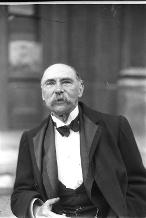
‘The Necessity for De-Anglicising Ireland’ by Douglas Hyde, was delivered to the Irish National Literary Society in Dublin, on 25th November, 1892. Thereafter it was published in The revival of Irish literature, 1894. |
Douglas Hyde (1860-1949) was the son of a ‘Church of Ireland clergyman’, and spent his early years living in Kilmacranny, Co. Sligo until 1867 and then in Frenchpark, Co. Roscommon.[1] In 1884 he graduated from Trinity College in the arts and law but pursued a literary and academic career.[2] Most of Hyde’s literary work was focused in the ‘study and preservation of the Irish language’ and from 1909 to 1937 he was a professor of Irish at UCD.[3] In 1892, he was elected as the first president of the newly established Irish National Literary Society, in which he delivered his inaugural speech: ‘The Necessity for De-Anglicising Ireland’ on 25th November, 1892.[4] Soon after he assisted Eoin MacNeill to establish the Gaelic League of which he also became president until he resigned in 1915.[5] Hyde became the ‘first president of Ireland under the 1937 constitution’ and served until 1945; he died on 12 July, 1949 and was given a state funeral.[6] Hyde’s speech was meticulously written to induce a sense of shame in the Irish for losing their cultural identity through Anglicisation. The speech was also articulated to rouse the responsibility of the Irish to reclaim their culture and support a cultural revival. Hyde claimed that Ireland was once ‘one of the most classically learned and cultured nations in Europe’ but had diminished to become ‘one of the least so’.[7] He implied that this was due to men who dropped their Irish names for English ones and who knew nothing of Gaelic literature but preferred to read the ‘garbage of vulgar English weeklies’.[8] He remarked on ‘the illogical position’ of Irishmen who dropped ‘their own language to speak English’, who listened to English music in place of their own and even dressed like the English.[9] Yet Hyde was curious as to how, ‘Irish sentiment’ was stuck ‘in this half-way house’, as the Irish hated the English yet, by imitating the English, the Irish were losing their language and had ‘thrown away with a light heart the best claim’ that the Irish had to be recognised internationally ‘as a separate nationality.’[10] Hyde warned that if Anglicisation continued, the rulers of the Empire would succeed to stamp out ‘every spark of national feeling [. . .] every thought and every idea that was Irish’ and the fact that the Irish were not of Saxon origin would be dropped out of sight and memory.’[11] In explaining the origins of Irish identity as separate to that of the Saxon, Hyde identified that Ireland was a ‘descendent of Ireland of the seventh century’, being that of the Celts.[12] He remarked on early Irish literature as an example to best understand ‘what that race really was’.[13] He implied that the only damage done to ‘the continuity of the Irishism of Ireland [was] in the north-east of Ulster, where the Gaelic race was expelled and the land planted with aliens.’[14] Hyde further discussed the idea of Ireland and Irish identity being that of a ‘Gaelic nation’ and a ‘Celtic race’ and in reference to a possibility of Home Rule, he maintained that just at the moment when the Celtic race is presumably about to largely recover possession of its own country, it finds itself deprived and stript [sic] of its Celtic characteristics cut off from the past, yet scarcely in touch with the present [. . .] despoiled of the bricks of nationality.[15] Hyde insisted that ‘every Irish feeling Irishman, who [hated] the reproach of West-Britonism’ should promote efforts to revive the ‘once great national tongue.’[16] For Hyde, in the areas where the language was still in use, there should be ‘nothing less than a house-to-house visitation and exhortation of the people themselves will do, something – though with a different purpose – analogous to the procedure that James Stephens adopted throughout Ireland when he found her on the dissecting table.’[17] For others, ‘the principal point’ said Hyde would be ‘the necessity for encouraging the use of Anglo-Irish literature instead of English books [and] [e]very house should have a copy of Moore and Davis.’[18] In Hyde’s conclusion, he insisted that the Irish ought to ‘strive to cultivate everything that is most racial, most smacking of the soil, most Gaelic, most Irish, because in spite of the little admixture of Saxon blood in the north-east corner, this island is and will ever remain Celtic at the core’.[19] Hyde finished the speech with an appeal to ‘everyone whether Unionist or Nationalist’, as it was ‘no political matter’, to do their best to assist ‘the Irish race to develop in future upon Irish lines’.[20] Both Stewart and Maume suggest that Hyde’s address ‘led to the formation of the Gaelic League’ in July 1893, with Hyde as the president.[21] The Gaelic League (Conradh na Gaeilge), was set up to be a non-political, non-sectarian organisation ‘aimed at involving people of different religious and political loyalties in a common cultural effort’ through the revitalization of the Irish language and ‘the preservation of Irish literature, music and traditional culture.’[22] The League had over 500 branches by 1905 and engaged in the production of culture through Irish language, music and dance, and a weekly Irish newspaper called An Claidheamh Soluis.[23] There were 600 branches by 1908 Irish was ‘established as a National School subject’ due to a strong lobbying campaign organised by the League.[24] Hyde wrote this speech carefully to combine eloquence with rebuke; he was passionate in his sense of cultural nationalism; yet abrasive in his reproach of the Irish for losing their culture. Throughout the speech Hyde’s debate was very clear about his concerns for the revival of Irish culture especially the Irish language and he was to some extent patriotic, though claimed his address was ‘no political matter’. However, one can not help but ponder on this as at the time of the speech there was ‘nationwide despondency’ due to the fall of Parnell, the split in the IPP and then a national mourning for the death of Parnell.[25] Thus, is it possible that Hyde’s speech denoted hints of Nationalist propaganda and even separatism? In terms of revolutionary or
counter-revolutionary forces at work in the period, Stewart claims that ‘there was nothing manifestly subversive’ in
Hyde’s speech.[26] Nonetheless Hyde’s comments on James
Stephens struck ‘an ominous note’ as Hyde clearly hinted ‘that the
Fenian method of political organization should be adopted in taking Irish
revivalism to the people’.[27] Furthermore, Stewart notes that Hyde’s language in the speech was subtly flavoured in
places with the ‘sentimental writing’ of Thomas Davis and Charles Gavin Duffy.[28] Although,
in this speech Hyde mistakenly credited James Stephens with the image of Ireland
as a ‘corpse on the dissecting table’, however, this was ‘a citation of
Sir Charles Gavan Duffy's celebrated coinage that had entered the literary
blood stream of Young Ireland
tradition.’ [29]
Thus, Hyde’s speech was carefully written to ‘strike a chord with that prolific,
potent, and addictive brand of sentimental writing that had sustained for half
a century the idea of a national literature in Ireland.’[30]
Davis was ‘an anti-modern’ who wrote on the
importance of the national language but also christened Anglicisation as a
‘“plague of utilitarianism and [sic] industrialis-ation”’ which threatened Ireland.[31] Nonetheless, Hyde and Davis differed
in that Davis’s position was ‘more pluralistic
than that which Hyde and his disciples were to subscribe to when they adopted
the theory that Ireland
was essentially and irreducible Gaelic.’[32] Indeed, Stewart claims that Hyde’s
speech ‘provided a central plank of propaganda for the Irish separatist
movement through its insistence that Ireland’ was a Gaelic nation with a
‘Celtic to the core’ identity.[33]
Stewart continues that it was ‘this strain of cultural nationalism more
compellingly than the political and economic tenets of Irish republicanism, per se, which led to the assertion of
Irish national sovereignty in the period from 1921 to strand of nationalism was eventually woven into the 1937 Constitution wherein the Irish state laid claim to a territory coextensive with that of the old insular nation of Gaelic Ireland (Articles 2, 3), and also named Irish as both the “national language” and the “first official language” of the country (Article 8).[35] Hyde’s ideas of Ireland and Irish identity, of being a ‘Gaelic nation’ and of the ‘Celtic race’ were later taken further by extreme Irish nationalists to mean an exclusive Gaelic Ireland with an Irish Celtic identity. This exclusiveness combined with expressions of de-Anglicisation may also have been misinterpreted by the Ulster Unionists at the time and given rise to a further separation of Ulster from Home Rule, especially by Hyde’s references to the North East being ‘planted with aliens’ and in his insinuations that Ireland was ‘Celtic to the core’ regardless of ‘the little admixture of Saxon blood in the north-east corner’. This type of language did Indeed, Stewart questions Hyde’s reasoning and asks ‘how Hyde, a Roscommon man, could imagine that the Scottish Presbyterians who made up the Unionist majority could be characterized as a strain of ‘Saxon blood’.’[36] Moreover, as the Gaelic League progressed, it gave birth to an Irish (Celtic) ethnic nationalism and this exclusiveness gave rise to a further separation of Ulster unionists from Home Rule as Ulster Unionism took on a new shape with an ethnic strand of Britishness.[37] Therefore, Irish nationalist and Ulster unionist identities were further exaggerated in opposition to each other. According to Dunleavy and Duleavy, Hyde saw the Gaelic League and its policy of deanglicization, [as] a way of separating Ireland from England in the most effective way possible. Once that task was accomplished—once Ireland felt and thought and moved like a nation—there was every chance, he still believed, that the continuing pressure for Home Rule would be irresistible, and that Ireland would be able to achieve legislative independence on its own terms without the use of physical force. [38] Therefore, Hyde had envisioned the League to remain a non-political and non-sectarian organisation. However, while the Gaelic League was founded as a cultural mass movement in counter-hegemony to Anglicisation, ‘“but its very success in reviving the national spirit helped to inspire the separatist movement, and it became clear that the language and the political struggle could not be kept apart."’[39] Furthermore, the League soon found itself with a forging of Irish (Celtic) ethnic nationalist identities who infiltrated throughout the entire organisation, and included ‘a number of the signatories of the 1916 Proclamation of the Irish Republic’, and a reason why Hyde would resign in 1915.[40] [1] See Gareth Dunleavy, Douglas Hyde. (Lewisburg [Pa.]: Bucknell University Press, 1974) p. 15. [2] Donnchadh Ó Corráin, ‘Douglas Hyde’, Movements for Political & Social Reform, 1870–1914, (UCC – Multitext Project in History, c.2011) [online] <http://multitext.ucc.ie/d/Douglas_Hyde3344120424> [accessed 26 February, 2013]. [3] Ó Corráin, ‘Douglas Hyde’, [online]; See Patrick Maume, ‘Hyde, Douglas (de hÍde, Dubhghlas)’, in James McGuire and James Quinn (eds.), Dictionary of Irish Biography, [online] (UK: Cambridge University Press, 2009) [accessed 25 February, 2013]. [4] See Maume, ‘Hyde, Douglas (de hÍde, Dubhghlas)’, [online]. [5] Maume, ‘Hyde, Douglas (de hÍde, Dubhghlas)’, [online]. [6] Maume, ‘Hyde, Douglas (de hÍde, Dubhghlas)’, [online]. [7] Douglas Hyde, ‘The Necessity for De-Anglicising Ireland’, in Duffy, G., Sigerson, G., Hyde, D. The revival of Irish literature, (London: T. F. Unwin, 1894) p. 118, Source: Internet Archive [online]. [8] Hyde, ‘The Necessity for De-Anglicising Ireland’, p. 159. [9] Hyde, ‘The Necessity for De-Anglicising Ireland’, pp. 118-119; pp. 154-159; p. 154-159. [10] Hyde, ‘The Necessity for De-Anglicising Ireland’, p. 119 [11] Hyde, ‘The Necessity for De-Anglicising Ireland’, p. 122. [12] Hyde, ‘The Necessity for De-Anglicising Ireland’, p. 126. [13] Hyde, ‘The Necessity for De-Anglicising Ireland’, p. 124. [14] Hyde, ‘The Necessity for De-Anglicising Ireland’, p. 127. [15] Hyde, ‘The Necessity for De-Anglicising Ireland’, pp. 128-129. [16] Hyde, ‘The Necessity for De-Anglicising Ireland’, p. 136. [17] Hyde, ‘The Necessity for De-Anglicising Ireland’, p. 138. [18] Hyde, ‘The Necessity for De-Anglicising Ireland’, p. 159. [19] Hyde, ‘The Necessity for De-Anglicising Ireland’, p. 159. [20] Hyde, ‘The Necessity for De-Anglicising Ireland’, p. 161. [21] Bruce Stewart,‘On the Necessity of De-Hydifying Irish Cultural Criticism’, New Hibernia Review / Iris Éireannach Nua, Vol. 4, (1), p. 23, (Spring, 2000), Source: Jstor [online] [accessed 28 February, 2013]; see Maume, ‘Hyde, Douglas (de hÍde, Dubhghlas)’, [online]. [22] National Library of Ireland, ‘Douglas Hyde, Eoin MacNeill, and the Gaelic League’ 1916 Rising: Personality and Perspectives, (online exhibition, 3. 4 .2.) [online] <http://www.nli.ie/1916/pdf/3.4.2.pdf> [accessed 27 February, 2013]. [23] National Library of Ireland, ‘Douglas Hyde, Eoin MacNeill, and the Gaelic League’ 1916 Rising: Personality and Perspectives, (online exhibition, 3. 4 .2.) [online] <http://www.nli.ie/1916/pdf/3.4.2.pdf> [accessed 27 February, 2013]. [24] Stewart, ‘On the Necessity of De-Hydifying Irish Cultural Criticism’, p. 25. [25] See Brian Ó Cuív, ‘Introduction’ in Hyde, D. A literary History of Ireland from earliest times to the present day, new ed., (London: Benn, New York: Barnes & Noble, 1967) p. xi. [26] Stewart, ‘On the Necessity of De-Hydifying Irish Cultural Criticism’, p. 24. [27] Stewart, ‘On the Necessity of De-Hydifying Irish Cultural Criticism’, p. 24. [28] See Stewart, ‘On the Necessity of De-Hydifying Ireland’, p. 21. [29] Stewart, ‘On the Necessity of De-Hydifying Irish Cultural Criticism’, p. 24; also see Stewart, ‘On the Necessity of De-Hydifying Ireland’, p. 22. [30] Stewart, ‘On the Necessity of De-Hydifying Ireland’, p. 21. [31] Stewart, ‘On the Necessity of De-Hydifying Ireland’, p. 21. [32] See Stewart, ‘On the Necessity of De-Hydifying Ireland’, p. 22. [33] Bruce Stewart, ‘On the Necessity of De-Hydifying Ireland’, Fortnight , No. 316, Supplement: The Future of Irish (Apr., 1993), p. 20, Source: JSTOR [online] [accessed 18 February, 2013]. [34] Stewart, ‘On the Necessity of De-Hydifying Ireland’, p. 20, (authors italics). [35] Bruce Stewart,‘On the Necessity of De-Hydifying Irish Cultural Criticism’, New Hibernia Review / Iris Éireannach Nua, Vol. 4, (1), p. 23, (Spring, 2000), Source: Jstor [online] [accessed 28 February, 2013]. [36] Stewart, ‘On the Necessity of De-Hydifying Irish Cultural Criticism’, p. 27. [37] Hugh Kearney, ‘The importance of being British’, Political Quarterly, [online], 71 (1), p. 21, (Oxon: Blackwell Publishers, 2000), Source: Academic Search Complete, EBSCOhost [accessed 23 February, 2013]. [38] Janet Egleson Dunleavy and Gareth W. Dunleavy, Douglas Hyde: A Maker of Modern Ireland, (Berkeley: University of California Press, c1991) p. 313, Source: UC Press E-Books Collection [online]. [39] Boylan, [40] National Library of Ireland, ‘Douglas Hyde, Eoin MacNeill, and the Gaelic League’ 1916 Rising Personality and Perspectives, (online exhibition, 3. 4 .2.) [online] <http://www.nli.ie/1916/pdf/3.4.2.pdf> [accessed 27 February, 2013]. |
|